
Every event organizer hopes to sell tickets well ahead of the event. The psychology of buying can help: how you present the price, which ticket types you offer and the details of your ticket sales page all affect how easily a buyer makes the decision. This article covers ticket pricing, ticket types, sales timing and ticket sales page conversion optimization.
When promoting your event’s ticket sales, pay attention to:
- Pricing psychology
- The communicative power of ticket types
- Ticket sales timing
- Ticket sales page conversion optimization
1. Pricing psychology
Everyone knows the ticket price matters when deciding whether to buy. But it is not only about the price – it is also about how the price is presented to the buyer. Try these:
- Uneven prices: The buyer reads a price from left to right, so the first digit weighs the most. That is why €49 feels clearly cheaper than €50. The effect appears when the first digit changes: €49 and €50 differ in this respect, €45 and €49 do not. (Thomas & Morwitz 2005)
- Anchoring: People compare a price to the first number they see. Try showing the VIP ticket (€179) first and the basic ticket (€129) after it, so the basic ticket looks cheaper. (Tversky & Kahneman 1974)
- Three ticket types: When there is a low-priced, a mid-priced and a high-priced option, buyers often pick the middle one. (Simonson, Sela & Sood 2017) The effect is weaker when the buyer pays real money, so follow what happens in your own event’s sales. (Müller, Kroll & Vogt 2012)
2. The communicative power of ticket types
A ticket type does more than enable different price levels – it shapes attendees’ expectations of the event before it even starts. Ticket types can also speed up ticket sales:
- Early bird: A cheaper ticket now, or a higher price later? Remember to state clearly how much more the next ticket type costs!
- VIP ticket: VIP adds exclusivity and raises the value of the event experience. Communicate the limited availability clearly: “limited number”, “only 50 tickets”.
- Group or company ticket: Let people buy several tickets at once for a slightly lower price. Company tickets bought under one person’s name let you choose who attends closer to the event! In Eventilla, minimum and maximum purchase quantities for group registration prevent a group ticket from being bought individually.
Tip: Tell exactly what each ticket type includes. In Eventilla, you can for example give ticket types their own tab on the ticket sales page. Discount codes and hidden tickets work well for speakers’ and invited guests’ tickets: you share the purchase link only with them.
3. Ticket sales timing
The timing of ticket sales depends heavily on the nature of the event. Tickets to big festivals for the following year are often released right after the previous event ends, while ticket sales for smaller events typically start a few months before the event. Whatever the schedule, it is worth dividing ticket sales into three phases:
- Presale: Release early bird tickets even before the final program is confirmed. In this phase, marketing should be tightly targeted – invite your core audience and people who have attended your events before.
- Ticket sales: When regular-priced tickets go on sale, widen your marketing targeting and invest in content marketing. Use people who have already bought tickets to convince new buyers: “200 seats already sold!”
- Last-minute sales: As the event approaches, it is usually possible to raise the price. Use FOMO in your marketing: “last tickets”, “don’t miss out”.
In a recent survey, the early bird price influenced buyers the most, while a countdown timer was not seen as persuasive. Use scarcity only when it is real. (LAB Focus 6/2026)
Looking for a system to sell your event tickets? Read about ticket sales with Eventilla.
4. Ticket sales page conversion optimization
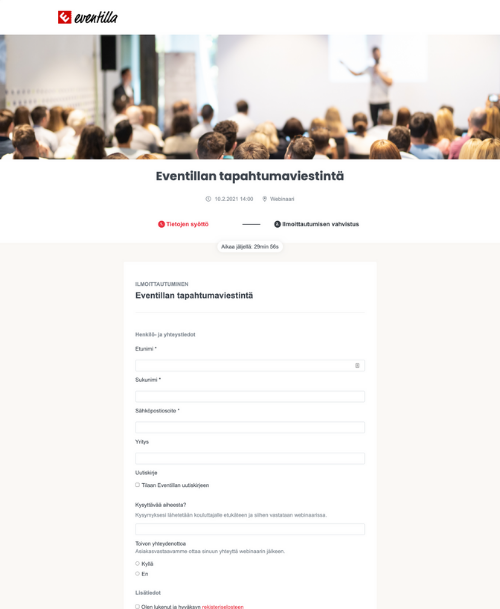
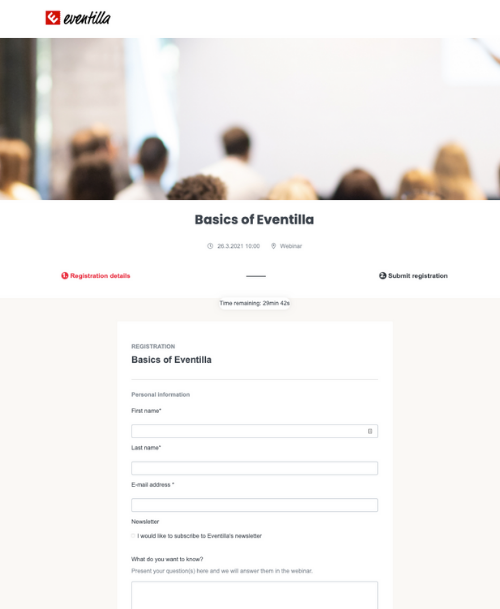
It is extremely important to remove any barriers to buying from the ticket sales page. In addition to the technical functionality of the page, pay attention to a few psychological tricks that carry the purchase decision over the line.
- Clear CTA: Make sure the buy button never has to be searched for. A distinctive, clear and large CTA makes sure the purchase is not postponed but made right away.
- Reassurance about security: Briefly explain the cancellation policy, and describe how the online payment works and why it is safe. “You will be redirected to the payment provider’s page to pay online” or “Pay securely by invoice”
- References: Show the number of tickets already sold next to the ticket sales, or add the best bits of feedback from the previous event to convince attendees. Others’ choices influence our own: in a hotel, a sign telling that most guests reuse their towels got more guests on board than an environmental appeal. (Goldstein, Cialdini & Griskevicius 2008) Providers with a narrow audience benefited more from popularity information than providers with a broad audience. (Tucker & Zhang 2011)
Read more about ticket sales page conversion optimization.
Summary – to buy a ticket or not? The psychology behind the purchase decision
Buying a ticket is not just a rational decision – it is a strongly psychological process in which pricing, options and communication steer the buyer’s thinking at an unconscious level. A purchase decision rarely arises from a single reason, but from the combined effect of many small signals.
By using methods that have proven psychologically effective – such as anchoring, a sense of scarcity and social proof – you can influence how attractive your event looks and how quickly tickets move. When ticket types speak to different audiences, sales phases build up logically and the ticket sales page removes obstacles from the buying path, you make the decision to attend more likely.
Remember: a purchase decision is not made with reason alone – but with feeling, momentary impulse and expectations of the experience. Invest in how the ticket feels – not only in what it costs.
Sources
- Thomas & Morwitz (2005). Penny Wise and Pound Foolish: The Left-Digit Effect in Price Cognition. Journal of Consumer Research 32(1).
- Tversky & Kahneman (1974). Judgment under Uncertainty: Heuristics and Biases. Science 185(4157).
- Simonson, Sela & Sood (2017). Preference-construction habits: The case of extremeness aversion. Journal of the Association for Consumer Research 2(3).
- Müller, Kroll & Vogt (2012). Do real payments really matter? A re-examination of the compromise effect in hypothetical and binding choice settings. Marketing Letters 23(1).
- Goldstein, Cialdini & Griskevicius (2008). A Room with a Viewpoint: Using Social Norms to Motivate Environmental Conservation in Hotels. Journal of Consumer Research 35(3).
- Tucker & Zhang (2011). How Does Popularity Information Affect Choices? A Field Experiment. Management Science.
- LAB Focus 6/2026: Why do we buy event tickets early? The role of scarcity in event marketing.
Read next:
What to consider when choosing a ticket sales system? Read the 6 must-have features!
About the author
Kirjoittajasta