
Organising events and training always comes down to one thing: continuous, large-scale processing of personal data. When you collect registrations, you simultaneously gather an enormous amount of data – from names and billing details to special diets and accessibility needs.
The more information you collect, the greater your responsibility to protect it. Information security is not just a concern for the IT department; it is a shared task for the entire event organisation. Increasingly, it is also a direct sales argument and competitive advantage – B2B customers and public-sector operators in particular now know how to demand strict information security from their subcontractors.
In this article, we go through why information security is at the heart of event and training management, what to consider when procuring software, and how to build a seamless “security chain” that holds up to scrutiny from the very first registration all the way to the safe deletion of data. Along the way, we also highlight practical examples of how we have solved these challenges in our own Eventilla event management system.
Why is information security especially important in the events industry?
Event and training organisations process an exceptionally wide range of personal data. In addition to ordinary contact details and job titles, forms often collect health-related information (such as allergies), payment details and, in some cases, even sensitive data relating to special groups. According to Article 9 of the General Data Protection Regulation (GDPR), there are very strict requirements for processing such special categories of personal data (such as health information).
On top of this, the events industry is by nature exceptionally networked. Information moves constantly between the organiser, the event planner, speakers, and accommodation and catering partners. Every such data transfer is a potential weak link. Information security is therefore never confined to the walls of your own organisation; it extends across the entire chain that handles a participant’s data in one way or another.
Want to dive deeper into the topic? We also cover the processing of personal data and event organisers’ legal obligations more broadly elsewhere on our blog.
Information security vs. data protection – what are we actually talking about?
These two concepts are easily confused in everyday language, but there is a clear and important difference between them:
- Data protection concerns how and on what legal basis personal data may be collected and processed. It is about people’s privacy, their rights, and compliance with legislation.
- Information security, on the other hand, refers to the concrete technical and organisational measures by which data protection is implemented and data is protected against unauthorised access, alteration, loss and leakage.
In practice, the two always go hand in hand: even the best data protection policy is of little use if the technical information security of the systems themselves fails. From an event organiser’s perspective, both must be built into the processes from the very start.
Information security in software and system procurement
A large part of an event organisation’s information security is decided at the very stage when the team selects an event or training management system. A tool unsuited to its purpose can pose a constant risk – whereas a responsible system carries part of the information security burden for you.
When procuring a system, you should always at least clarify the following basics:
- Data location and transfers: Where is the data physically stored and where is it processed? A server and data processing located within the EU or EEA significantly simplifies the fulfilment of data protection obligations. If data is transferred outside the EU, the legality of the transfer mechanisms must always be demonstrable.
- Encryption: Is the data encrypted both in transit (when it travels across the internet) and at rest (when it is stored in a database)? Today, this should be a built-in minimum requirement that the customer should not have to demand separately.
- Access control: Can access rights be restricted on a role-by-role basis within the system, so that, for example, a catering partner sees only the allergies but not the participants’ names or billing details? Does the system support multi-factor authentication (MFA) or the company’s own single sign-on (SSO)?
- Data lifecycle and deletion: Can you delete or anonymise personal data automatically once the event is over and the data is no longer needed? Hoarding data in Excel files “just in case” is one of the biggest – and most needless – risks in the industry.
- The supplier’s certifications: Can the software supplier provide impartial evidence of the security of its processes, such as an ISO 27001 certificate for its information security management system? And does the supplier have a ready data processing agreement (DPA) that clearly defines the parties’ responsibilities?
- Incidents: How does the software supplier act in the event of a data breach, and how quickly does it report it? The GDPR requires breaches to be reported within a strict deadline, and this chain must work seamlessly at the subcontractor’s end as well.
Asking these questions at the request-for-proposal stage quickly reveals a software supplier’s level of maturity. A reliable partner is able to answer these questions openly and with documentation.
In Eventilla’s SaaS service, for example, information security is built in from the start. Participant data is processed securely within the EU, access control is strictly role-based, and the data lifecycle – such as the automatic anonymisation of data after the event – has been made as effortless as possible for the organiser. Eventilla’s information security management system is independently ISO/IEC 27001 certified – as the first software specialising in event and training management in Finland.
Get your security chain in order – identify the risk points!
A single technical firewall is not enough if the overall process leaks. The easiest way to picture an event’s data management is to think of it as a security chain that is exactly as strong as its weakest link.
An event and training organiser’s security chain runs roughly like this:
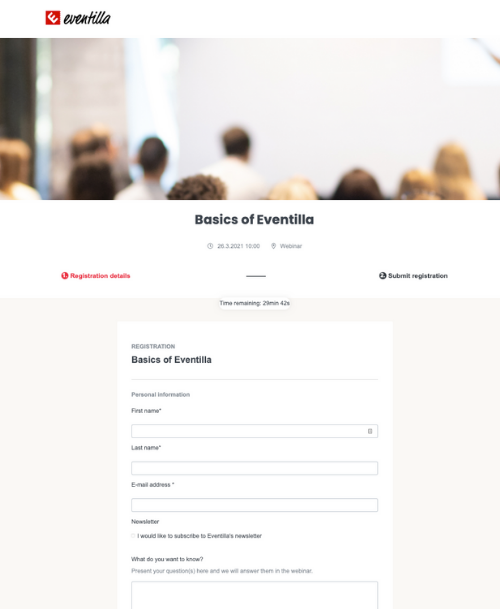
- Collecting the data: On the registration form, collect only what you really need. Always tell the participant clearly what the data will be used for (e.g. mandatory acceptance of the privacy statement on the form).
- Transferring the data: Make sure the data moves via encrypted API connections or secure reporting tools – not as unprotected email attachments or open Google Sheets spreadsheets.
- Storing the data: Store the data in a centralised, access-controlled system designed for processing personal data. Avoid exporting lists out of secure systems.
- Using and sharing the data: Strictly limit who can access which data. When you share data with partners or subcontractors, remember that they become part of your chain. In Eventilla, for example, you can share a password-protected report containing only the special diets with the caterer, and schedule the link to stop working as soon as lunch has been served.
- Deleting the data: The chain only ends once the data has been safely destroyed. When the event is over and the legal retention period has expired, anonymise the personal data in a controlled manner.
It is essential to understand that the chain never breaks off at the boundary of your organisation. When you outsource part of the data processing to a software supplier or a marketing partner, your responsibility as the organiser does not disappear – your chain simply gets longer.
A centralised system like Eventilla, built as an enterprise-grade solution, helps keep this security chain strong. When registrations, communications and reporting all flow through the same system, data does not need to be scattered across emails and disconnected tools. The fewer separate links there are in the chain, the easier and safer the whole is to manage.
The human factor is often the weakest link
Technology solves a lot, but the majority of data breaches and data leaks still stem from human error: shared joint credentials, weak passwords, an Excel file sent to the wrong email address, or phishing.
In event organisations, which often employ a broad network of staff, volunteers and seasonal workers, this human risk is heightened. Clear internal guidelines, regular onboarding, and clear procedures for incident situations are of the utmost importance. When everyone working on the event understands their role in the security chain, the whole organisation grows stronger.
Summary
Information security in event and training management is not a single IT project, but a continuous way of operating that runs through the entire organisation: it begins with a considered choice of system, runs through the security chain, and ultimately relies on the people who use the tools. When you build information security and data protection into your processes from the very beginning, you protect not only your organisation’s reputation but also the trust of your participants – and in the events industry, trust is the most valuable currency of all.
Eventilla offers a durable, independently audited foundation for information security: an EU-based, ISO/IEC 27001-certified event and training management solution that keeps the security chain under control from the very first click to the safe deletion of data.

Shall we make information security management easy?
Frequently asked questions (FAQ)
- What is a special category of personal data, and does it apply to event organisers? Special categories of personal data are sensitive data defined in Article 9 of the GDPR, such as data relating to health, beliefs or ethnic origin. In the events industry, this most often concerns health data: for example, food allergies and accessibility needs may fall into these categories. Collecting and storing them requires particular care from the organiser and a stronger legal basis for processing than ordinary contact details.
- Should participants’ data be encrypted, and what does encryption mean in practice? Yes. Data should be encrypted both in transit (when it travels across the internet from the form to the server) and at rest (when it is stored in a database). In practice, encryption means that the data cannot be intercepted in transit, nor read even if someone gains unauthorised access to the server.
- What does ISO/IEC 27001 certification guarantee for an event organiser? ISO/IEC 27001 is an international standard for information security management systems. Certification means that an independent, accredited external party has verified that the software supplier’s way of managing information security meets the requirements of the standard. For the organiser, it provides impartial evidence with which they can demonstrate to their own customers, members and trainees that the data is in safe hands throughout the entire chain.
About the author
Kirjoittajasta